Gray Eyes: How Rare They Are & Why They Aren't Just Blue
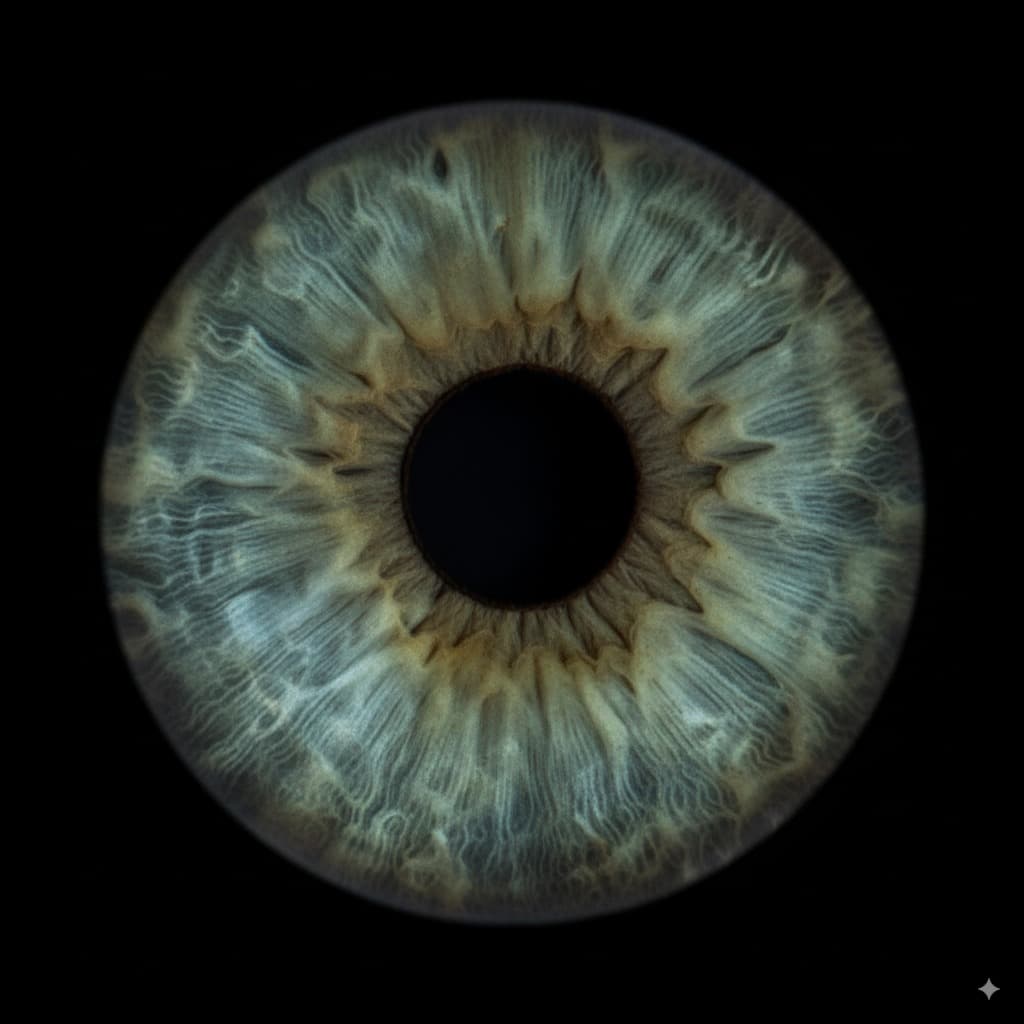
Gray eyes are one of the rarest eye colors on Earth — held by under 1% of people by most estimates — and also one of the most misunderstood. The reason is simple: gray is constantly mistaken for blue. On paper they look like cousins, both pale and low-pigment, but there is a real, physical difference between them, and it comes down to something most people have never heard of: the density of collagen inside the iris. This guide explains how rare gray eyes really are, why gray is not just a shade of blue, the genetics behind it, where gray eyes come from, and why they seem to change color through the day.
What Are Gray Eyes?
Gray eyes are a low-melanin iris color that reads as silver, steel, or slate rather than blue, green, or brown. A true gray iris looks almost colorless — closer to polished metal than to a hue — and it can lean cool and icy or deep and stormy. Shades run from pale, luminous light or silver gray to a moody dark gray that can pass for charcoal in dim light.
Like blue and green, gray is a color your eye perceives rather than a pigment you actually have. Human irises only ever contain two pigments: melanin (brown to black) and a small amount of yellowish lipochrome. There is no gray pigment and no blue pigment anywhere in the human eye. Gray, blue, and green all come from having very little melanin and letting the physical structure of the iris scatter light — and, as we will see, gray is what you get when that structure scatters light in a particular way. (British English spells it grey; the color and the science are identical.)
How Rare Are Gray Eyes?
Gray eyes are genuinely rare. Most estimates put them at under 1% of the world's population, which makes them one of the rarest of all the naturally occurring eye colors — in the same scarce tier as, and by many counts below, green. Here is where gray sits relative to the other major eye colors:
| Eye color | Approx. global share | Rarity |
|---|---|---|
| Brown | 55–79% | Most common |
| Blue | 8–10% | Common |
| Hazel | ~5% | Uncommon |
| Amber | ~5% | Uncommon |
| Green | ~2% | Rare |
| Gray | <1% | Rarest (non-medical) |
There is real uncertainty in that number, and it is worth understanding why. Gray is the most undercounted eye color of all, because so many surveys never give it its own box. A great deal of research — including some large studies and even driver's-license and passport systems — folds gray into a single "blue/gray" category. When that happens, most gray eyes get logged as blue, and gray as a standalone color all but disappears from the data. So the honest answer is that gray is rare and probably rarer than the tidy 1% suggests, but the exact figure depends heavily on who is counting and whether they bothered to separate it from blue at all.
Regionally, the global figure hides a familiar pattern. Gray is overwhelmingly a Northern and Eastern European trait, and in its heartlands around the Baltic it is far from unusual. Move outside those regions and gray becomes vanishingly uncommon: it is extremely rare across Asia, Africa, and the Americas, where high-melanin brown eyes are the near-universal default. For the full ranking of every eye color by rarity, see our rarest eye color guide.
Gray vs Blue: Why Gray Isn't Just Blue
This is the single most interesting fact about gray eyes, and the one almost nobody gets right. Gray and blue are not the same color under different lighting. They are two genuinely different structural colors — and the reason is a subtle difference in how the iris is built.
Start with what they share. Both gray and blue eyes are low-melanin, structural colors. Neither one contains a drop of blue or gray pigment. In both cases, the front layer of the iris — a semi-transparent sheet of tissue called the stroma — has so little melanin that its color is produced almost entirely by the way it scatters incoming light. The dark backing of the iris absorbs the rest, so what you see is only the scattered light bouncing back toward you.
Here is where they split. What decides whether that scattered light looks blue or gray is the amount and density of collagen fibers in the stroma:
- Blue eyes have a relatively sparse, open stroma. Light passing through it undergoes mostly Rayleigh scattering — the same physics that makes the sky blue — which preferentially scatters the shorter, bluer wavelengths back toward you. Result: blue.
- Gray eyes have more collagen, packed more densely, in that same layer. Denser fibers scatter light differently: instead of favoring blue, they produce more Mie-type scattering, which scatters all wavelengths of visible light more evenly. When every color comes back at once, the mix reads as white, silver, or gray rather than blue. Result: that steely, near-colorless gray.
That is the whole trick. It is the same reason a fine mist or a bank of thick cloud looks white while a clear sky looks blue — Mie scattering off larger, denser particles washes out the color and returns something closer to white. In a gray iris, densely packed collagen does exactly that to the light, which is why gray eyes look like brushed metal instead of a bright blue.
Melanin still gets the final vote on the exact shade. A gray iris with essentially no pigment looks clean, cool, and silvery. Add just a touch of melanin and the same eye picks up a warmer or deeper cast — a whisper of pigment can tip gray toward gray-blue, and a trace of yellow lipochrome laid over the gray can nudge it toward gray-green. This is why gray sits so close to blue and green on the spectrum: they all start from the same low-pigment, light-scattering foundation, and only a small change in structure or pigment separates one from the next.
| Color | What it looks like | Why |
|---|---|---|
| Blue | Clear blue, pupil to rim | Sparse stroma, mostly Rayleigh scattering (favors blue) |
| Gray | Silver, steel, near-colorless | Dense stroma collagen, more Mie scattering (washes to white) |
| Gray-blue | Cool blue with a silvery haze | Dense collagen plus a trace of melanin |
| Gray-green | Muted gray leaning green | Gray base with a thin layer of yellow lipochrome |
The practical upshot: if your eyes look pale but distinctly silver or slate — especially if they seem to lose their color and go almost white in bright light — that points to gray, not blue. A true blue eye stays recognizably blue across conditions. For the other side of this comparison, see our blue eyes guide.
The Genetics Behind Gray Eyes
Because gray sits right beside blue, it rests on the same genetic foundation. Both are low-melanin colors, and both trace back to the well-studied machinery that turns iris pigment down. As with every other eye color, this is polygenic — controlled by at least 16 genes working together, not the single dominant-or-recessive gene the old school textbooks described.
The two most important genes are the same ones that steer blue, green, hazel, and brown:
- OCA2 controls how much melanin your melanocytes produce in the iris. Gray eyes, like blue, sit at the very low end of OCA2 activity — little enough pigment that the structure of the stroma, not melanin, sets the color.
- HERC2 sits right next to OCA2 and acts as its volume control. The well-known variant at position rs12913832 turns OCA2 down, and the low-pigment combination that produces blue eyes across Northern Europe is the same background that gray arises from.
What separates gray from blue is not a single famous mutation. It appears to come from the finer details — how the stroma is built and how densely its collagen is laid down — shaped by additional pigment- and structure-related genes such as SLC24A4, SLC45A2, TYR, and IRF4 that genome-wide studies have tied to eye color. Because gray depends on this subtle structural difference on top of a blue-like genetic base, it is one of the hardest colors to predict from DNA. Consumer DNA tests call brown or blue with around 90% accuracy, but their confidence drops sharply for the in-between and low-pigment shades — gray very much included. For the full walk-through, read our eye color genetics guide.
Where Do Gray Eyes Come From?
Gray eyes are concentrated in Northern and Eastern Europe. The highest rates cluster around the Baltic Sea — gray is notably common in the Baltic states, Russia, and across Scandinavia and Finland, with pockets throughout Central and Eastern Europe. It is one of the signature light-eye colors of the region.
The pattern tracks the same low-melanin gene variants that produced blue eyes, which spread through Northern European populations over the last several thousand years. Gray shares that genetic background almost entirely, so it concentrates in the same regions as blue — which is also why it is almost absent in populations where brown eyes are universal. In practical terms, gray is what happens when a blue-eyed genetic backdrop meets a denser iris structure, so it turns up in the same places blue does, just far less often.
Why Gray Eyes Seem to Change Color
Gray eyes are famous for looking different from one hour to the next — silver in the morning, blue-gray by a window, almost green against the right sweater. There is a real reason for it, and it is not the mood-ring myth. The honest explanation is optical: a gray iris has almost no pigment of its own to fix a color, so it borrows heavily from whatever light and color surround it. Low-melanin eyes are the most affected by their environment of any eye color, and gray — the lowest-pigment of all — is the most affected of the lot. Here is what is actually happening:
- Ambient light. Because gray reflects light fairly evenly, it takes on the temperature of the light hitting it. Cool daylight and an open sky make gray look bright and silvery, even faintly blue; warm indoor bulbs pull the same eyes toward a soft, muted gray-gold.
- What you wear and what's nearby. Your brain judges color by contrast. A blue shirt lends a gray eye a blue cast; an olive or green top can coax out a gray-green; black and white make gray look at its most pure and steely. The eye itself hasn't changed — its surroundings have.
- Pupil size. When your pupil widens in low light or narrows in bright light, the iris tissue compresses or stretches, and the apparent shade shifts a little darker or lighter along with it.
All of that is apparent change — an optical effect, not a change in pigment. Your eyes are responding to light and contrast, not to your mood. Genuine, permanent change happens in only two situations. The first is infancy: many babies are born with low-pigment blue or gray eyes, and the final color settles in over roughly the first one to three years as melanin builds up — some babies who start gray stay gray, while others shift to blue, green, or hazel. The second is medical: a sudden, lasting change in one eye only, or a change paired with pain or vision problems, can signal conditions like Horner's syndrome or Fuchs heterochromic iridocyclitis, and certain glaucoma eye drops can darken iris color over time. If you notice a real, one-sided change, see an eye doctor.
Dark gray vs light gray
Not all gray eyes look alike. Light or silver gray eyes have the least pigment and the most even light scattering — they look luminous and almost reflective, and they change the most with their surroundings. Dark gray eyes carry a little more melanin, or a denser structure still, which deepens them toward slate, storm, or charcoal; in dim light they can read almost brown-gray. Both are true gray — the difference is a small amount of pigment sitting on top of the same silvery, structure-driven base.
How to Tell If You Have True Gray Eyes
Because gray overlaps so heavily with blue, gray-blue, and gray-green, it is one of the hardest colors to judge by eye. Here is a reliable, low-tech checklist:
- Use bright, neutral daylight. Stand near a window during the day, not under warm indoor bulbs, which can make gray look bluer or muddier than it is.
- Get close to a mirror. Look at your iris from a few inches away so you can read the actual color rather than an overall impression.
- Ask whether it's a hue or a metal. True gray reads as silver, steel, or slate — closer to a non-color than a distinct blue. If it's recognizably blue, it's blue or gray-blue, not pure gray.
- Watch it wash out in bright light. A telltale sign of gray is losing color and going almost silvery-white in strong daylight — that is Mie scattering at work.
- Rule out gray-green. If there's a clear greenish tint layered over the gray, it's gray-green rather than true gray.
The catch is that human eyes — including your own — are unreliable color judges, especially for a near-colorless shade like gray that borrows tone from everything around it. The fastest way to settle it is pixel-level analysis. The MyEye AI Eye Color Identifier reads a single iris photo, separates the color zones, and tells you the exact color and sub-shade — including whether you're true gray, gray-blue, or gray-green — plus how rare your specific shade is globally. It runs free in your browser with no signup, and there are also free iOS and Android apps if you'd rather scan from your phone.
Gray Eyes Meaning & Symbolism
Because they are so scarce, gray eyes have gathered a good deal of cultural meaning. In literature and folklore they are often linked to wisdom, depth, and a certain cool intensity — the Greek goddess Athena, the embodiment of wisdom and strategy, was described with the epithet glaukopis, usually translated as "gray-eyed" or "bright-eyed." In modern culture gray eyes are simply read as striking and enigmatic, largely because they are rare and hard to pin down.
It is worth being clear-eyed about this: these associations are cultural and symbolic, not scientific. Eye color does not determine personality, intelligence, or temperament. What is genuinely remarkable about gray eyes is the physics — the near-zero pigment, the dense collagen, the Mie scattering that turns light to silver — and that is extraordinary enough on its own.
Frequently Asked Questions
How rare are gray eyes?
Gray eyes are one of the rarest colors — under 1% of people worldwide by most estimates, rarer than green (~2%), hazel (~5%), amber (~5%), blue (8–10%), and brown (55–79%). The true figure is uncertain because many surveys use a single "blue/gray" category, so a lot of gray eyes get counted as blue. Gray is most common around the Baltic and across Northern and Eastern Europe.
What's the difference between gray and blue eyes?
Both are low-melanin structural colors with no actual pigment. The difference is in the stroma, the front layer of the iris. Blue eyes have a sparse stroma and mostly Rayleigh scattering, which favors blue. Gray eyes have more, denser collagen there, which produces more Mie-type scattering — it scatters all wavelengths evenly and comes back closer to silver or white than blue.
Why do gray eyes seem to change color?
Gray eyes have very little pigment, so their color is largely borrowed from the light around them. Ambient light, nearby clothing, and pupil size all shift the apparent shade between silver, gray-blue, and gray-green through the day. It's a real optical effect — a response to light and contrast, not the mood-ring myth — and the underlying pigment doesn't change.
Where are gray eyes most common?
In Northern and Eastern Europe. Gray clusters around the Baltic Sea and shows up frequently in Russia, the Baltic states, Scandinavia, and Finland. The same low-melanin genetics that give Northern Europe its blue eyes also produce gray, so the two overlap. Gray is extremely rare where high-melanin brown eyes dominate.
Are gray eyes real and natural?
Yes. Gray is a genuine, natural eye color — not blue eyes in certain light, and not the product of contacts or filters. It's produced like every light eye color: low melanin plus the structure of the iris. What makes gray distinct is the denser collagen in the stroma, which scatters light toward silver rather than blue.
Can gray eyes turn blue or green?
They can look blue or green depending on the light, but that's an optical shift, not a real pigment change — the color is stable in adulthood. Some gray eyes have a permanent gray-blue or gray-green cast from a trace of melanin or lipochrome. Genuine, lasting change happens mainly in infancy, as a baby's eyes settle over the first one to three years, or medically, which warrants an eye doctor.
Sources & Further Reading
- Cleveland Clinic. (2024). Eye Colors: Hazel, Green, Amber, Blue, Grey & Brown.
- Simcoe, M. et al. (2021). Genome-wide association study in 195,000 individuals identifies 50 previously unidentified genetic loci for eye color. Science Advances.
- MedlinePlus Genetics. Is eye color determined by genetics? U.S. National Library of Medicine.
- American Academy of Ophthalmology. Iris Anatomy and Function.
Related Reading
- Blue Eyes: How Rare They Are, the Genetics & Why They're Blue
- Green Eyes: How Rare Are They? Genetics & Why They Look the Way They Do
- Hazel Eyes: How Rare They Are, Genetics & Why They Change
- Amber Eyes: The Rare Golden Iris Explained
- Brown Eyes: The World's Most Common Eye Color Explained
- The Rarest Eye Color: 2026 Definitive Ranked Guide
- Eye Color Genetics: What Actually Determines Your Eye Color
- AI Eye Color Identifier (the tool)
Written by the MyEye - AI Eye Scanner & Iris Analyzer Team. For educational and entertainment purposes only. Not medical advice. Population percentages cited are global averages drawn from peer-reviewed studies and may vary by region and methodology.
Last updated: July 2, 2026.